
When people think about what makes a piece of land valuable, they usually think about location, acreage, road frontage, zoning, or access to water and sewer.
Stormwater infrastructure rarely makes the top of that list.
But when land is being evaluated for development, drainage can quickly become one of the most important parts of the property. How rainwater moves across a site, where it collects, and where it eventually goes can influence everything from the amount of usable land to the cost and complexity of developing it.
For landowners in South Carolina, understanding stormwater does not mean becoming an engineer. It simply means recognizing that what happens to water after a heavy rain can have a real effect on how a property is viewed by developers and other potential buyers.
What Is Stormwater Infrastructure?
Stormwater is rainwater that flows across the ground instead of immediately soaking into the soil.
On undeveloped land, some rainfall is absorbed naturally by vegetation and soil. The rest may travel through low areas, ditches, wetlands, streams, or other natural drainage paths.
Development changes that balance.
Roads, rooftops, driveways, sidewalks, parking areas, and other hard surfaces prevent water from soaking into the ground as easily. That creates additional runoff that needs somewhere to go.
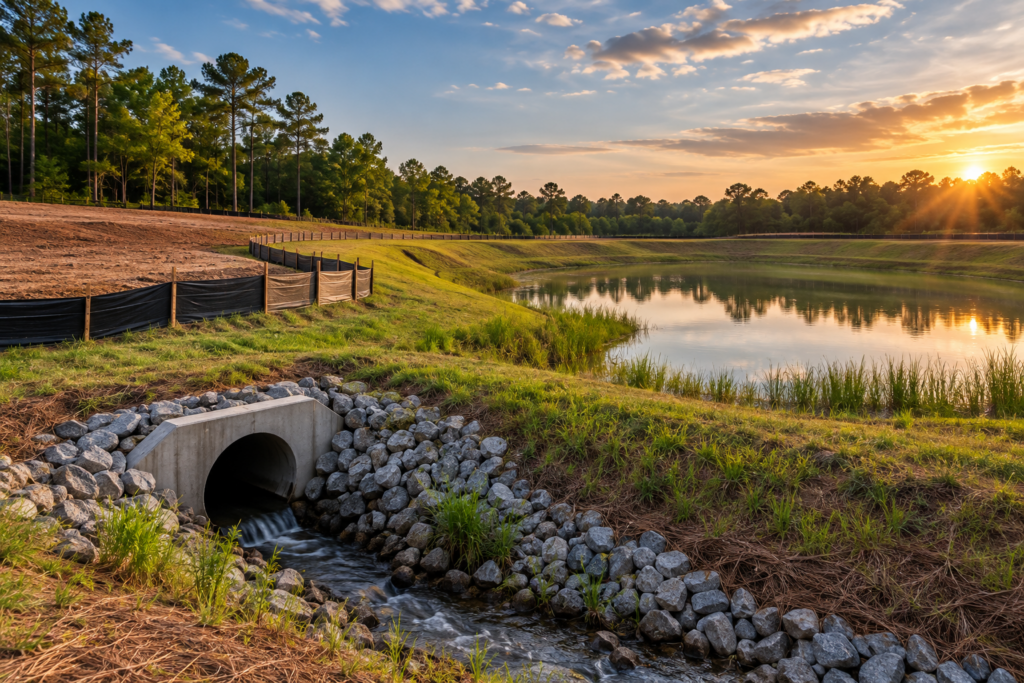
Stormwater infrastructure is designed to manage that runoff. Depending on the property and proposed development, it may include detention or retention ponds, drainage pipes, roadside ditches, swales, culverts, catch basins, drainage easements, and other systems that collect or redirect water.
For a landowner, the important point is simple: stormwater management takes space.
A 30-acre property, for example, does not necessarily provide 30 acres that can be divided into homesites or other development areas. Some land may need to remain available for drainage facilities, buffers, wetlands, roads, utilities, or other infrastructure.
That is one reason developers look beyond total acreage when determining what a property may be worth.
Why Drainage Can Affect a Property’s Development Potential
Two properties with the same acreage and zoning can have very different development potential.
Imagine two 20-acre tracts located near each other.
One has relatively favorable topography and a clear drainage path. The other contains several low areas and receives runoff from surrounding properties.
On paper, they may look similar. Once engineering begins, however, the second property could require a larger stormwater pond, additional drainage improvements, or more land dedicated to managing runoff.
That can reduce the number of lots or amount of buildable area available.
Stormwater planning may also influence where roads can go, where lots can be placed, and which portions of a property are practical to develop.
This is why developers often study topography, flood information, wetlands, soils, existing drainage features, and nearby infrastructure early in their evaluation.
For landowners trying to understand the development potential of their property, our South Carolina County Real Estate resources can also provide useful context about how location, infrastructure, zoning, and local development standards work together.
Stormwater Requirements Can Vary by Location
Stormwater is not handled exactly the same way everywhere in South Carolina.
State requirements establish an overall framework for managing runoff from construction activity, but counties, cities, and other local jurisdictions may have additional stormwater and land-disturbance requirements.
Some properties are also located within regulated municipal storm sewer areas, commonly called MS4 areas. These jurisdictions have responsibilities related to construction runoff and post-construction stormwater management.
The amount of land being disturbed matters as well. Larger developments generally face more extensive stormwater review, and smaller projects can sometimes fall under broader requirements when they are part of a larger development plan.
Coastal properties may require additional consideration because of their proximity to receiving waters and the environmental conditions common to the region.
For a landowner, the takeaway is not that every property will face complicated permitting. It is that stormwater requirements are site-specific.
The same development concept placed in two different counties—or sometimes two different jurisdictions within the same county—may encounter different review processes or design requirements.
Existing Drainage Is Worth Paying Attention To
Landowners often know more about their property’s drainage than they realize.
Maybe one corner stays wet for several days after a storm. Perhaps a ditch along the road carries a significant amount of water during heavy rain. Maybe water regularly crosses the property from an adjoining tract.
Those observations can be valuable.
Some basic questions worth considering include:
- Where does water collect after a heavy rain?
- Are there existing drainage ditches or culverts?
- Does runoff enter the property from neighboring land or roads?
- Are there creeks, wetlands, ponds, or other low areas nearby?
- Has any part of the property experienced repeated flooding?
- Are there recorded drainage easements?
- Does the property appear to sit significantly higher or lower than surrounding land?
None of these conditions automatically makes a property unsuitable for development.
They simply give engineers and developers a better understanding of what may need to be addressed.
In fact, an existing drainage feature may sometimes be incorporated into a future development plan. In other situations, it may create additional engineering work or limit where improvements can be placed.
The answer depends heavily on the individual site.
Why Stormwater Matters When Selling Vacant Land
When a developer evaluates vacant land, the purchase price is usually tied to what can realistically be built—not simply the number of acres shown on the tax record.
That is why stormwater can indirectly affect land value.
If a significant portion of a property is needed for drainage infrastructure, the site’s usable acreage may be reduced. If major improvements are required to safely move or store runoff, those costs may also become part of the developer’s feasibility analysis.
This does not mean landowners should build stormwater ponds or commission detailed engineering studies before selling.
In many cases, those expenses are better handled during a buyer’s due diligence period.
However, gathering information you already have can make the evaluation process easier. Surveys, plats, drainage easements, previous engineering work, flood information, wetland studies, utility maps, and records of previous development proposals can all provide useful context.
If you’re considering selling, our Sell Your Land page explains more about how we evaluate properties and the information that can help during the process.
A Small Piece of a Much Larger Picture
Stormwater is only one part of determining whether land can support future development.
Zoning, density, utilities, wetlands, access, road frontage, topography, environmental conditions, and local development standards all play a role.
But drainage deserves attention because it connects with many of those issues.
A property may have favorable zoning and nearby utilities, yet still require careful planning because of how water moves across the site. Another property may appear challenging at first but have a workable drainage solution once engineers study it.
That is why land development decisions are rarely made from acreage alone.
Understanding how stormwater fits into the bigger picture can help landowners have more informed conversations with developers, engineers, municipalities, and potential buyers—and better understand why a buyer may need time for engineering and feasibility studies before moving forward.
If you own land in South Carolina and are exploring your options, our team is always happy to share insights and answer questions. You can visit our Contact Us page to start a conversation about your property.