
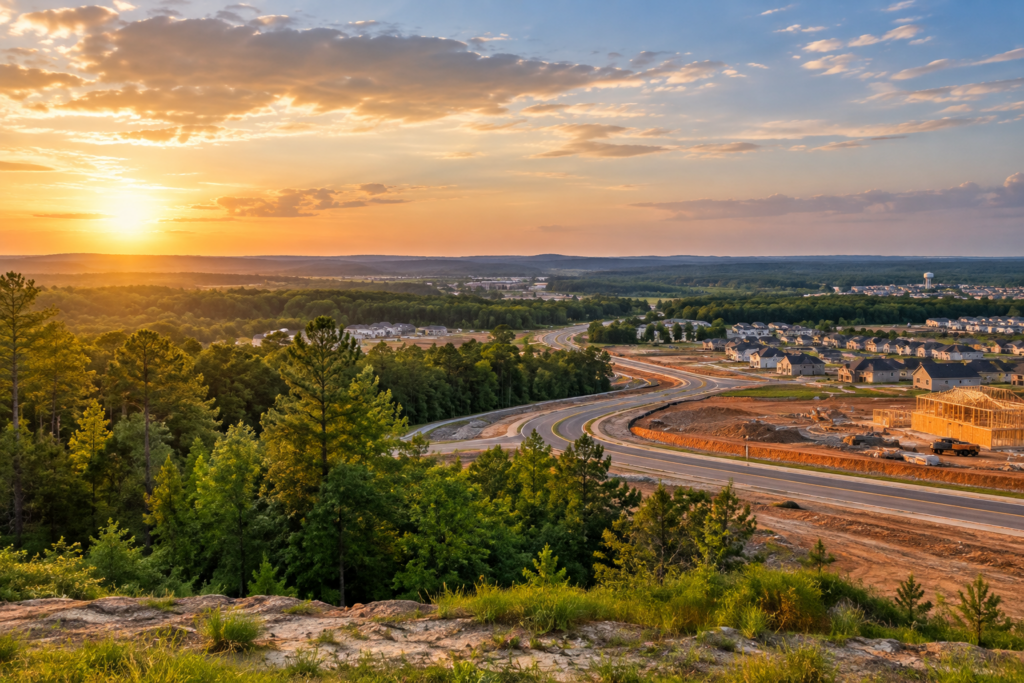
Growth is usually viewed as a positive sign for a real estate market. More people can mean more jobs, more businesses, more homes, and greater demand for land.
But growth also creates a practical challenge: infrastructure has to keep up.
Across South Carolina, communities are expanding into areas that were once largely rural or lightly developed. Roads that were designed for modest traffic volumes are serving more residents. Water and sewer systems are being extended or upgraded. Schools, utilities, drainage systems, and public services are also adjusting to increased demand.
For landowners, this creates an important distinction. Being located in a growing market does not automatically mean a property is ready for development.
In many cases, the real question is whether the infrastructure surrounding the property can support what comes next.
Growth Can Move Faster Than Infrastructure
Population growth can happen relatively quickly. Infrastructure usually cannot.
A new subdivision may take a few years to move from planning to construction, but expanding a wastewater treatment plant, widening a highway, building a new pump station, or extending a major water line can involve years of engineering, permitting, funding, and construction.
That difference in timing can create growing pains.
A property may sit near expanding neighborhoods and new commercial development, yet still lack sufficient sewer capacity. Another property may have water nearby but face road-access limitations. In some areas, drainage or stormwater requirements may become increasingly important as surrounding land is developed.
This is why two similar properties only a few miles apart can have very different development potential.
One may already have the infrastructure necessary to support residential development. The other may require significant off-site improvements before development becomes financially practical.
For landowners trying to understand what their property may be worth to a developer, those details matter.
Water and Sewer Can Be the Deciding Factor
Water and sewer availability are among the first things developers investigate when evaluating land.
Seeing a fire hydrant or utility line along a nearby road does not necessarily mean a property can immediately connect.
Developers typically need to understand questions such as:
- Where are the nearest water and sewer mains?
- What size are the existing lines?
- Is there enough capacity for additional development?
- Would a sewer pump station be required?
- Would lines need to be extended?
- Who would pay for those improvements?
- Does the utility provider have plans to expand service in the area?
These questions can significantly change the economics of a project.
Imagine two 30-acre properties in the same general market.
Property A has adequate water and sewer directly along its frontage.
Property B has water nearby, but sewer is several thousand feet away and would require an extension and possibly a pump station.
On a map, the properties may appear equally attractive. From a development standpoint, however, the cost difference could be substantial.
That does not necessarily make Property B undesirable. It simply means the infrastructure costs have to be considered when determining what type of project makes sense and what a developer can reasonably pay for the land.
Roads, Traffic, and Access Matter Too
Utilities are only part of the infrastructure equation.
As communities grow, road capacity becomes increasingly important. A property may have plenty of acreage and favorable zoning, but the surrounding road network still has to support the traffic generated by development.
Depending on the size and type of project, developers may need to evaluate road frontage, driveway access, intersection conditions, turn lanes, traffic studies, or off-site road improvements.
A parcel with strong frontage on an adequate road may therefore have an advantage over a similar parcel served by a narrow rural road.
This becomes particularly important along the edges of fast-growing communities.
Land that was historically used for agriculture, timber, or a single residence may suddenly be surrounded by subdivisions. The land itself has not changed, but the infrastructure expectations around it have.
For landowners in rapidly changing areas, understanding those expectations can provide a much clearer picture of development potential.
Internal link opportunity: A county- or city-specific resource such as South Carolina County Real Estate can help readers understand how development conditions differ from one local market to another.
Infrastructure Can Affect Timing as Much as Value
Infrastructure challenges do not always prevent development. Sometimes they simply delay it.
A developer may identify a property that fits the long-term direction of a market but determine that the surrounding infrastructure is not ready yet.
For example, a utility provider may already have plans for a future sewer extension. A road widening project may be scheduled. A municipality may be expanding its service area. A new school or public facility may also be planned nearby.
In those situations, land can become more practical to develop as infrastructure catches up.
This is one reason land value should not always be viewed as a single fixed number.
Development potential can change over time as roads, utilities, zoning policies, neighboring projects, and public investments change.
A parcel that is difficult to develop today may look very different several years from now.
The opposite can also happen. If infrastructure reaches capacity or development standards become more demanding, additional costs may affect what developers are willing to pay.
For owners considering whether to sell now or hold their property, understanding local infrastructure plans can be just as useful as reviewing recent land sales.
What Landowners Should Look at Before Selling
Landowners do not need to become engineers or land planners before considering a sale. But having a basic understanding of a property’s infrastructure can make conversations with potential buyers much more productive.
Start with the practical questions.
Where are the closest public water and sewer lines? Is the property inside a utility service area? What road provides access? Are major developments being built nearby? Have surrounding properties recently been rezoned or subdivided?
It can also be helpful to look beyond what exists today.
County planning documents, utility expansion plans, transportation projects, annexation activity, and nearby development applications can provide clues about where growth may move next.
This is especially important in areas transitioning from rural to suburban development.
A landowner may look at a property and see acreage that has remained mostly unchanged for decades. A developer may look at the same property and immediately consider utility capacity, road access, wetlands, zoning, density, and the cost of extending infrastructure.
Understanding that difference can help explain why offers for seemingly similar properties sometimes vary significantly.
If you’re considering selling, our Sell Your Land page can also provide an overview of how the process works and what information is typically reviewed when evaluating a property.
Growth Creates Opportunity, but Infrastructure Shapes It
South Carolina continues to attract residents, businesses, and development, but accommodating that growth requires more than simply finding available land.
Communities need roads that can handle additional traffic. Homes need reliable water and wastewater service. Drainage systems need to manage additional runoff. Utilities need sufficient capacity. Local governments have to plan for schools, emergency services, and other public needs.
For landowners, that means location is only one part of the development equation.
A property’s relationship to existing and planned infrastructure can influence its development potential, timeline, and ultimately how developers evaluate the land.
That is why understanding what is happening around a property can be just as important as knowing how many acres it contains.
If you own land in South Carolina and are exploring your options, our team is always happy to share insights and answer questions. You can visit our Sell Your Land or Contact Us page to start a conversation.