
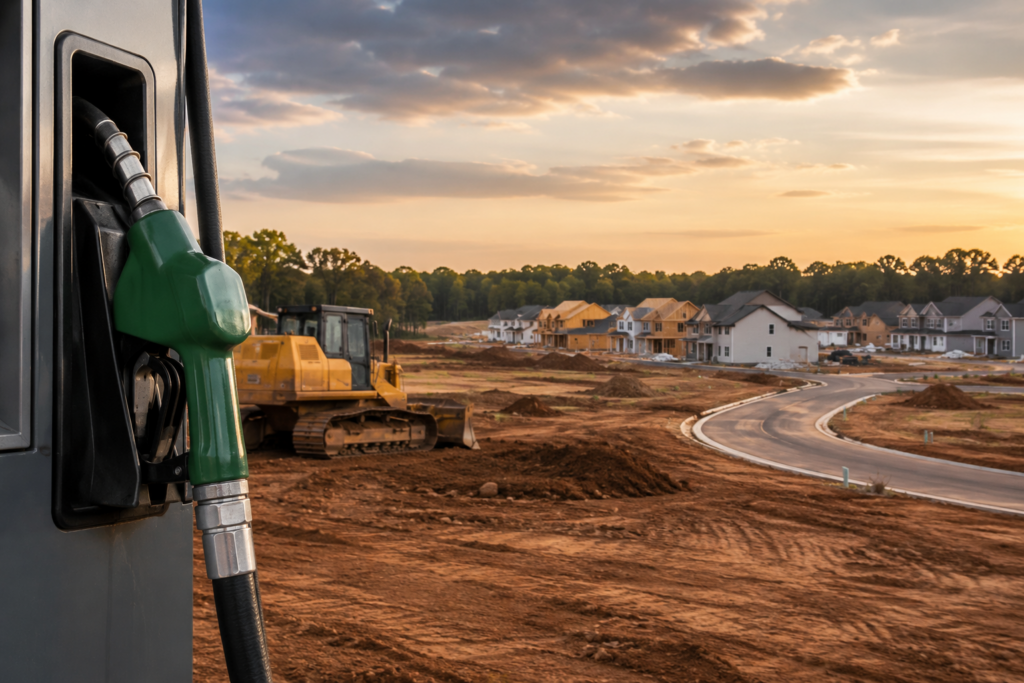
When fuel prices rise, most people notice the change at the gas pump first. For landowners, though, the impact can reach much further.
Fuel is tied into nearly every stage of residential development. Heavy equipment needs diesel to clear and grade land. Trucks haul dirt, stone, concrete, lumber, and other materials. Contractors travel between job sites. Utility crews bring equipment to properties. Even the cost of getting finished homes and communities connected to the surrounding area can be affected.
That means fuel inflation can influence what it costs to develop land, which projects builders are willing to pursue, and ultimately how developers evaluate vacant property in South Carolina.
For landowners, understanding that connection can provide useful context when evaluating an offer or deciding whether now is the right time to sell.
Fuel Costs Are Part of the Development Equation
Turning vacant acreage into a residential community requires a surprising amount of transportation.
Before construction begins, a property may need clearing, grading, excavation, drainage work, road construction, and utility installation. Much of that work depends on diesel-powered machinery, including excavators, bulldozers, graders, loaders, and dump trucks.
Materials also have to reach the site.
Stone may travel from a quarry. Concrete comes from a batch plant. Pipe, lumber, equipment, and other materials may travel significant distances before arriving at the property.
When fuel prices increase, contractors and suppliers often face higher operating and transportation costs. A relatively small increase on one delivery may not seem significant, but a large residential development can involve hundreds or even thousands of truck trips over the life of the project.
Fuel is only one piece of the development budget, but when it rises alongside labor, materials, infrastructure, permitting, and financing costs, the combined effect can become meaningful.
That matters because developers typically work backward when evaluating land.
They estimate what the finished lots or homes may eventually be worth, subtract development and construction expenses, account for risk and time, and then determine what they can reasonably pay for the property.
If development costs increase, there may be less room in that equation for the land itself.
Location Can Become Even More Important
Fuel inflation does not affect every property equally.
Two parcels with similar acreage and zoning can have very different development costs depending on where they are located.
Consider a 30-acre property near an established growth corridor. It has paved road frontage, nearby water and sewer, and easy access to suppliers and contractors.
Now compare it with another 30-acre property farther from existing infrastructure. The second site may require longer equipment mobilization, more trucking, utility extensions, and additional road improvements.
When fuel and transportation costs are relatively low, some of those differences may be easier for a developer to absorb.
When costs rise, they become harder to ignore.
This is one reason land close to existing infrastructure and active development corridors can be especially attractive. Developers are not simply looking at acreage. They are evaluating how efficiently that acreage can become usable residential lots.
For landowners researching their local market, this is also where county-level conditions matter. Development patterns in one part of South Carolina may look very different from another.
Internal link opportunity: Link here to a relevant county-specific resource, such as Horry County Real Estate and Land Development, Berkeley County Land Development, or another South Carolina county market guide.
Higher Development Costs Can Change What Builders Are Willing to Pay
Landowners sometimes see new homes selling for higher prices nearby and naturally assume that vacant land values should increase at the same pace.
The relationship is not always that simple.
A developer purchasing raw land has substantial expenses between acquiring the property and selling finished lots or homes.
Depending on the site, those expenses can include:
- Engineering and surveying
- Clearing and grading
- Roads and sidewalks
- Stormwater infrastructure
- Water and sewer installation
- Wetland mitigation or environmental work
- Permitting and impact fees
- Construction labor and materials
- Financing and carrying costs
- Fuel and transportation
Recent housing research in South Carolina has continued to identify development, infrastructure, transportation, and construction expenses as important factors affecting housing affordability and project feasibility.
When several of these costs rise at the same time, developers may become more selective.
A project that made financial sense under one cost structure may need to be redesigned, purchased at a different land basis, or postponed if the numbers no longer work.
For a landowner, this does not automatically mean the property has lost value. It means developers may place greater emphasis on characteristics that reduce uncertainty and future costs.
Infrastructure Can Help Protect a Property’s Development Potential
One of the most important factors in residential land development is infrastructure.
A property with public water and sewer nearby may be considerably easier to develop than acreage requiring major utility extensions. The same applies to road access, drainage, and proximity to existing communities.
This becomes particularly important when construction costs are elevated.
South Carolina housing officials have noted that development in rural areas can require new on-site infrastructure or connections to services provided by nearby municipalities, increasing the overall cost of development.
Imagine two properties offered at the same price per acre.
Property A has sewer at the frontage.
Property B requires a lengthy sewer extension before residential development can occur.
Even if Property B contains more usable acreage, the infrastructure expense could make Property A more attractive to a developer.
Fuel inflation can widen that difference because infrastructure construction often involves excavation equipment, hauling, pipe delivery, crews, and repeated equipment mobilization.
This is why landowners should be cautious about comparing their property only by acreage or nearby asking prices.
The better question is often: What would it actually take to develop this property?
Fuel Inflation Can Affect Housing Demand, Too
There is another side of the equation that receives less attention.
Fuel prices affect the people who eventually live in new communities.
Transportation costs are part of a household’s overall cost of living, particularly in areas where residents depend heavily on personal vehicles. State housing research has specifically noted that transportation expenses can add to housing affordability pressures, especially in rural areas where driving is often necessary for work, shopping, and services.
That can influence where builders see the strongest demand.
When commuting becomes more expensive, communities closer to employment centers, highways, schools, shopping, and everyday services may become more attractive to some households.
For developers evaluating land, location therefore matters from two directions.
It affects the cost of developing the property, and it affects the eventual marketability of the homes.
This is especially relevant in fast-growing areas of South Carolina, where new residential development continues to expand outward from established cities and towns.
What Should Landowners Pay Attention To?
Fuel prices alone should rarely determine whether someone sells their land.
Land value is influenced by many factors, including zoning, future land use plans, utility availability, wetlands, road frontage, surrounding development, population growth, builder activity, and the number of homes or lots that can realistically be developed.
Fuel inflation is better viewed as one part of the larger development-cost picture.
For landowners considering their options, it can be helpful to understand a few basic questions about the property:
Is public water available?
Is public sewer nearby?
What is the current zoning?
What does the county’s future land use plan show?
Are there wetlands or floodplain areas?
How much of the property is realistically buildable?
Are builders actively developing nearby?
What road or infrastructure improvements might be required?
Those factors can often tell you much more about a property’s development potential than a simple price-per-acre comparison.
A developer looking at vacant land is ultimately trying to determine how much risk, time, and money stand between the property today and a completed community.
Fuel and transportation costs are part of that calculation, but they are only one part.
Understanding Your Land in a Changing Cost Environment
Housing markets change. Fuel prices rise and fall. Construction expenses move with labor availability, material pricing, interest rates, and local development requirements.
Good land, however, is evaluated on fundamentals.
Location, infrastructure, zoning, access, usable acreage, and surrounding growth often matter far more over the long term than any single economic trend.
For landowners in South Carolina, understanding those fundamentals can make conversations with developers much easier. It also provides better context when comparing offers or deciding whether holding the property for future development makes sense.
Internal link opportunity: Naturally link to the Sell Your Land or Contact Us page here for owners who want to discuss their property’s development potential.
If you own land in South Carolina and are exploring your options, our team is always happy to share insights and answer questions.