
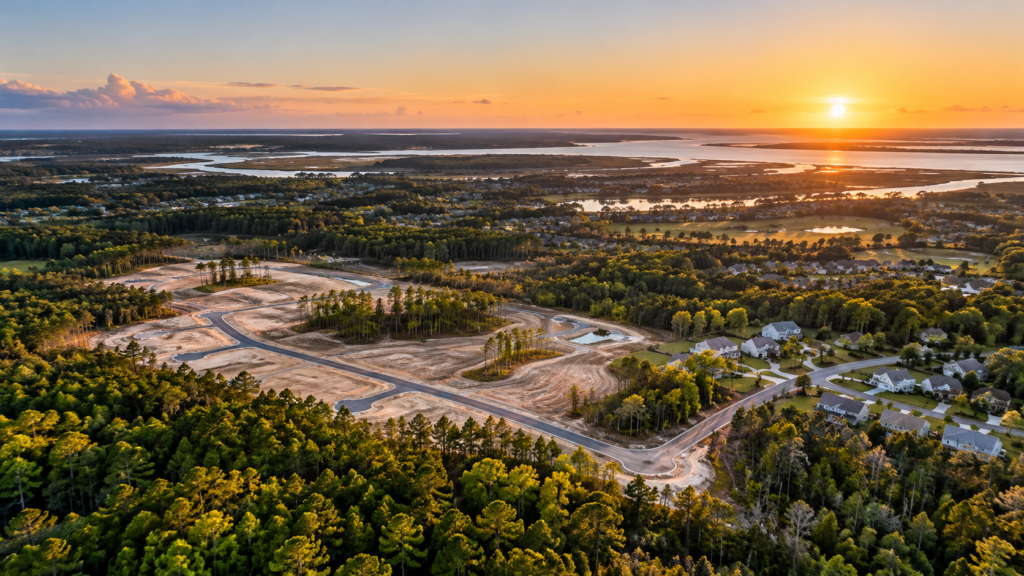
Brunswick County, North Carolina, has become an increasingly attractive area for residential development. With growing communities around Leland, Bolivia, Shallotte, and the southern coastal areas, more landowners are seeing interest in properties that may have once been considered too rural or too far from established neighborhoods.
But owning land in a growing county does not automatically mean that developing it will be simple.
As Brunswick County continues to manage residential growth, development approvals, infrastructure capacity, and environmental requirements have become important considerations for anyone looking to subdivide or sell vacant land.
For landowners, understanding how the approval process works can make a meaningful difference when evaluating a property’s potential. A parcel that looks suitable for a residential community on a map may still face challenges involving road access, stormwater management, utility availability, or local development standards.
Here’s what property owners should understand before making decisions about their land.
1. Development Approval Involves More Than Zoning
One of the most common misunderstandings about vacant land is that zoning alone determines whether a property can be developed.
Zoning is important, but it is only part of the process.
In Brunswick County, residential development proposals may be subject to subdivision regulations, site design standards, environmental requirements, and infrastructure reviews. The applicable process depends on the property’s location, proposed use, and development characteristics.
For example, a landowner may have a 40-acre property in an area that allows residential development. On paper, the acreage may appear large enough to support several dozen homes.
However, before that property can become a subdivision, a developer may need to evaluate:
- Whether the proposed lots meet minimum dimensional requirements
- Whether roads and access points satisfy applicable standards
- How stormwater runoff will be managed
- Whether public water and sewer service is available
- Whether wetlands or flood-prone areas affect the proposed layout
- Whether the project requires additional local or state permits
These factors can significantly influence the number of homes a property can realistically accommodate.
It is also important to distinguish between unincorporated Brunswick County and properties located within municipal boundaries. Towns such as Leland, Shallotte, and Oak Island may have their own development ordinances and approval procedures.
What this means for landowners: Before assuming a property can support a particular number of residential lots, confirm the governing jurisdiction and applicable development standards.
2. Infrastructure Capacity Is Becoming a Major Part of Development Planning
As residential growth continues, infrastructure is one of the most important factors affecting land development throughout Brunswick County.
Roads, water lines, sewer systems, and drainage facilities all have to accommodate new development. Even when a property is appropriately zoned, infrastructure limitations can affect the cost and timing of a proposed project.
Consider a vacant parcel located near an established neighborhood.
There may be a public water line along the main road, but that does not necessarily mean the line has sufficient capacity to serve a new subdivision. Similarly, a nearby sewer connection does not guarantee that the existing system can accommodate additional homes without improvements.
Depending on the location and proposed development, a project may require utility extensions, engineering studies, system upgrades, or coordination with public service providers.
Road access can create similar challenges. A subdivision that adds substantial traffic may need additional access improvements or transportation review, depending on applicable requirements.
For a developer, these expenses become part of the overall feasibility calculation.
For a landowner, they can influence how much a buyer is willing to pay.
A property with accessible utilities and manageable infrastructure requirements may be more attractive than a similar-sized tract that requires extensive off-site improvements.
What this means for landowners: The distance to existing utilities is useful information, but confirmed service availability and capacity are far more valuable when evaluating development potential.
3. Stormwater, Wetlands, and Soil Conditions Can Change the Development Layout
Brunswick County’s coastal geography creates both opportunities and challenges for residential development.
Many properties contain a combination of sandy upland soils, poorly drained areas, wetlands, and locations with relatively shallow seasonal groundwater.
These conditions do not necessarily prevent development, but they can affect where homes, roads, and stormwater facilities can be placed.
A property that appears mostly open or wooded may still contain areas unsuitable for conventional residential construction without additional engineering.
For example, imagine a 60-acre tract where approximately 15 acres contain potentially hydric soils or low-lying drainage areas.
That does not automatically mean those 15 acres are legally protected wetlands or completely undevelopable. However, the conditions may warrant further investigation before a subdivision layout is prepared.
A developer may need to consider:
- Wetland delineation and applicable permitting requirements
- Seasonal groundwater levels
- Stormwater retention or treatment areas
- Soil stability for roads and building pads
- Grading and fill requirements
- Drainage patterns affecting neighboring properties
The amount of usable land may be considerably different from the property’s total acreage.
This distinction is especially important when evaluating larger vacant tracts intended for residential subdivisions.
Two properties with the same acreage may have very different development potential because of their soil characteristics, drainage conditions, and environmental constraints.
What this means for landowners: Understanding the physical characteristics of your property can help establish realistic expectations about its potential value for development.
For additional local context, consider linking to a related resource on Brunswick County vacant land and residential development opportunities.
4. Approval Timelines Can Affect How Developers Structure Land Purchases
Landowners sometimes wonder why a developer needs several months to evaluate a property before purchasing it.
The reason is that residential land development involves more than agreeing on a purchase price.
Before committing to a project, a developer may need to complete engineering evaluations, verify utility availability, study environmental constraints, prepare preliminary layouts, and determine whether the proposed development is financially feasible.
Depending on the project, the developer may also need to pursue subdivision approvals, coordinate with local planning staff, or obtain permits from state and federal agencies.
These activities take time, and some involve significant upfront expenses.
As a result, development-related land purchase agreements often include a due diligence or feasibility period.
During this period, the buyer investigates whether the property can support the intended project.
Some agreements also include provisions that make closing dependent on obtaining certain approvals or permits.
For example, a developer interested in purchasing 80 acres for a residential subdivision may need to determine whether the property can support 100 homes, 70 homes, or fewer.
The difference could substantially change the project’s financial feasibility.
This does not necessarily mean the developer is uncertain about purchasing the property. It means the buyer is evaluating the risks associated with turning vacant land into buildable residential lots.
What this means for landowners: When reviewing a development-related purchase offer, pay attention to the feasibility period, approval contingencies, extension options, earnest money terms, and anticipated closing timeline.
Understanding these provisions can help landowners compare offers beyond the proposed purchase price.
5. What Landowners Should Do Before Selling or Subdividing Property
For property owners in Brunswick County, preparation can help reduce uncertainty when discussing a potential sale or development opportunity.
A landowner does not necessarily need to hire an engineer or complete expensive studies before putting a property on the market.
However, gathering basic information can make conversations with prospective buyers more productive.
Start by confirming the property’s acreage, parcel boundaries, current zoning, and governing jurisdiction.
Next, review available information about road frontage, access, utilities, flood zones, and mapped soil conditions.
Brunswick County GIS records, local planning departments, and publicly available soil surveys can provide useful starting points.
It is important to recognize that these resources are preliminary. A GIS map cannot replace a boundary survey, a soil map does not establish the exact location of jurisdictional wetlands, and a nearby utility line does not confirm service capacity.
Landowners should also understand that development potential and market value are closely connected.
A large property with substantial environmental constraints may support fewer residential lots than a smaller property with favorable soils and existing infrastructure.
Similarly, a parcel located near an active growth corridor may still require significant investment before development can begin.
For owners considering a sale, these details can help explain why different buyers may arrive at different property valuations.
The goal is not to complete every development study in advance. It is to understand enough about the property to ask informed questions and evaluate opportunities realistically.
Final Thoughts: Understanding Your Land’s Potential
Brunswick County continues to attract interest from residential developers, but growth also brings greater attention to infrastructure, environmental conditions, and the development approval process.
For landowners, the important takeaway is that acreage and zoning do not tell the whole story.
Road access, utilities, soils, drainage, and local regulations all influence what can be built and how much a development project may cost.
Taking time to understand these factors can help property owners make better decisions, whether they plan to hold their land, explore subdivision opportunities, or consider selling to a developer.
If you own vacant land in South Carolina and are exploring your options, the team at Southern Acres Land Co. is always happy to share insights and answer questions. You can learn more through our Sell Your Land resources or reach out to discuss your property’s potential.