
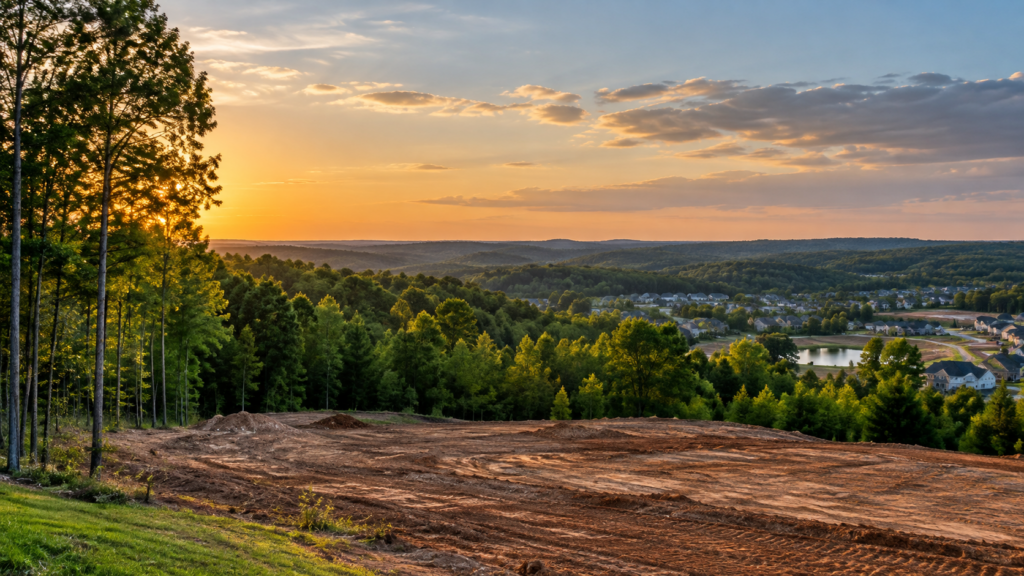
If you own a piece of land that has been in your family for years, you may assume its development potential has stayed more or less the same.
But land development does not stand still.
As communities grow, local governments regularly revisit how new neighborhoods affect roads, drainage, wetlands, utilities, open space, and nearby properties. A parcel that looked relatively straightforward to develop several years ago may face a different set of requirements today.
So, are development rules in South Carolina actually getting stricter?
In many growing areas, the practical answer is yes — or, at the very least, development is becoming more detailed and site-specific.
That does not necessarily mean land cannot be developed. It means understanding what can realistically be built on a property is becoming increasingly important before determining what that land may be worth to a developer.
Why Development Standards Change as Communities Grow
Development regulations usually do not become more detailed for one single reason.
Growth creates pressure on infrastructure and natural resources. More homes can mean more traffic, greater demand for water and sewer capacity, additional stormwater runoff, and more concern about how development affects neighboring properties.
Local governments have several tools available to manage those issues. Depending on the county or municipality, development standards may address things such as:
- Stormwater management
- Wetland and stream buffers
- Road access and connectivity
- Minimum lot dimensions
- Open-space requirements
- Tree preservation
- Flood-prone areas
- Water and sewer infrastructure
- Density and subdivision design
State-level stormwater requirements also play a role. Land-disturbing activities can require stormwater review and permitting, and projects that are part of a larger development plan may be regulated even when an individual portion of the project is relatively small.
For landowners, the important takeaway is that acreage alone does not determine development potential.
Two properties with the same number of acres can produce very different development plans depending on what is happening on and around the land.
Stormwater, Wetlands, and Buffers Matter More Than Many Owners Realize
One of the biggest changes in land development over time has been the amount of attention given to drainage and environmentally sensitive areas.
A 30-acre property, for example, does not automatically provide 30 acres that can be divided into residential lots.
A developer may need to account for wetlands, streams, floodplains, required buffers, stormwater ponds, road rights-of-way, utility areas, and other infrastructure.
Imagine that two neighboring owners each have 30 acres.
The first property is mostly upland, has good road frontage, and sits close to existing utilities.
The second contains wetlands through the center of the tract, requires additional buffers, and would need a significant sewer extension.
On paper, they have the same acreage. From a development perspective, however, they can be completely different properties.
That distinction becomes especially important in fast-growing markets where local governments are paying closer attention to drainage, flooding, and the long-term effects of new development.
Landowners in coastal and rapidly developing counties may want to learn more about local requirements through county-specific resources, such as our [Horry County Real Estate and Land Development] posts.
Infrastructure Can Be Just as Important as Zoning
Zoning is usually one of the first things people check when evaluating development land.
It is important, but zoning does not tell the whole story.
A property may have zoning that allows residential development and still face significant practical limitations.
For example, the site may need:
- A water-main extension
- A sewer-main extension
- A pump station
- Road improvements
- Additional access
- Stormwater infrastructure
- Utility easements
- Off-site improvements
Those costs can influence what a developer can afford to pay for the land.
This is why a property located near an existing subdivision or growing community can sometimes be more attractive than a similar property farther away. Existing infrastructure may make development simpler and reduce the amount of off-site work required.
It also explains why development pressure does not always move evenly across a county. Growth tends to follow infrastructure, available capacity, transportation corridors, employment centers, and existing communities.
More Rules Do Not Automatically Mean Your Land Has Less Value
Stricter development standards can sound negative from a landowner’s perspective, but they do not automatically make land less valuable.
Development value depends on the entire picture.
If regulations reduce the number of lots that can fit on a property, that can certainly affect a developer’s numbers. But strong demand for housing, nearby utility availability, favorable zoning, good access, and limited supplies of developable land can work in the opposite direction.
Consider a property where an older concept suggested 80 homes.
After accounting for updated stormwater requirements, buffers, infrastructure, and other development standards, a newer plan might support only 65 homes.
That does not automatically make the property unattractive.
A developer will look at what those 65 lots may ultimately be worth, how much infrastructure will cost, how long approvals may take, and whether enough margin remains to make the project feasible.
In other words, land value is not simply:
Acreage × Price Per Acre
For development land, value is often tied more closely to what can realistically be built and what it will cost to get there.
What Landowners Should Check Before Assuming a Property’s Potential
If you are thinking about selling land for development, an old appraisal, neighboring sale, or previous development concept can be helpful — but it should not be treated as the final answer.
Conditions may have changed since those documents were prepared.
A good preliminary review should look at the property’s current zoning and future land-use designation, available water and sewer service, road frontage and access, wetlands and flood zones, subdivision standards, surrounding development, and any significant infrastructure improvements that may be required.
It is also worth looking beyond the property boundaries.
Is a major residential community being built nearby? Has sewer service recently been extended? Is the county planning road improvements? Have nearby properties been rezoned?
Those details can sometimes be just as important as what is physically located on the property itself.
Landowners do not necessarily need to complete full engineering or entitlement work before considering a sale. However, having a basic understanding of these factors can make conversations with potential buyers much more productive.
Development Is Becoming More Site-Specific
The larger trend is not simply that development is becoming “harder.”
A better way to describe it is that development is becoming more site-specific.
Counties and municipalities are balancing new growth with drainage, transportation, environmental constraints, infrastructure capacity, and the concerns of existing communities.
As a result, developers have to study properties more carefully before committing significant money to them.
For landowners, that makes early due diligence increasingly valuable.
A tract that initially appears difficult may have development opportunities that are not immediately obvious. On the other hand, a property that looks perfect on a map may have infrastructure or environmental constraints that significantly change its development potential.
Understanding those details early can help owners form more realistic expectations about their land and evaluate offers with better context.
If you’re considering selling, our Sell Your Land page explains more about how we evaluate properties and the information that can be helpful during an initial review.
If you own land in South Carolina and are exploring your options, our team is always happy to share insights and answer questions. You can also reach us through our Contact Us page if you have questions about a specific property.